















What Are the Key Criteria for Selecting Pumps in Coal-Fired Power Stations?

Coal-fired power stations feature harsh and complex operating conditions, including high-temperature and high-pressure boiler feed water, abrasive fly ash slurry, and corrosive flue gas desulfurization (FGD) slurry. Selecting suitable pumps must prioritize four core dimensions: pressure resistance, temperature tolerance, wear resistance, and long-term operational reliability. These pumps serve as critical auxiliary equipment, and their performance directly affects the safety, efficiency, and energy consumption levels of power generation units. According to industry data, the energy consumption of pump systems accounts for 15-20% of the total auxiliary power consumption of coal-fired power stations, among which boiler feed pumps alone account for approximately 3.15% of the unit’s total power generation.
Authoritative standards are crucial for ensuring pump quality and performance. Pumps complying with API 610 standard (for centrifugal pumps for petroleum, petrochemical and natural gas industries) and ANSI B73.1 standard (for centrifugal pumps for general industrial use) are widely adopted in coal-fired power stations. These standards specify strict requirements for pump structural design, material selection, and performance testing, ensuring that pumps can operate stably for 8000+ hours annually under continuous 24/7 working conditions. In addition, the newly implemented mandatory national standard GB 21258—2024 (Energy Consumption Limits for Coal-Fired Power Generation Units) further emphasizes the energy efficiency requirements of pump systems, promoting the application of high-efficiency and energy-saving pump technologies.
Operating Condition Matching for Coal-Fired Power Station Pumps
Accurate matching of pump operating conditions with the process requirements of coal-fired power stations is the premise of ensuring stable and efficient operation. The following table lists the key operating condition parameters that need to be clarified for pump selection, combining the characteristics of typical process links such as boiler feed water, ash slurry transportation, and FGD:
Operating Condition Category | Key Parameters to Confirm | Impact on Pump Selection |
|---|---|---|
Medium Characteristics | Medium type (boiler feed water, condensate water, ash slurry, FGD gypsum slurry, circulating cooling water), chemical composition (chloride ion concentration, pH value) | Determines the corrosion resistance and material selection of pumps (e.g., FGD slurry requires chloride-resistant materials) |
Solid Particle Parameters | Solid content (%), maximum particle size (mm), particle hardness (fly ash/gypsum) | Affects the wear resistance and anti-clogging performance of pumps (ash slurry requires high-wear-resistant impellers) |
Thermal & Pressure Properties | Operating temperature (℃), working pressure (MPa), cavitation margin requirements | Decides the pressure resistance and temperature tolerance level of pumps (boiler feed water requires high-temperature and high-pressure resistant pumps) |
Operational Mode | Continuous operation (24h/365), annual operating hours, load fluctuation range | Influences the structural strength and energy efficiency optimization direction of pumps (continuous operation requires high reliability) |
Installation Requirements | Dry-type/Submersible/Vertical/Horizontal/Belt-driven installation, space constraints of pump rooms | Determines the pump type and structural layout (vertical pumps are preferred for limited space in pump rooms) |
Common Pump Types in Coal-Fired Power Stations
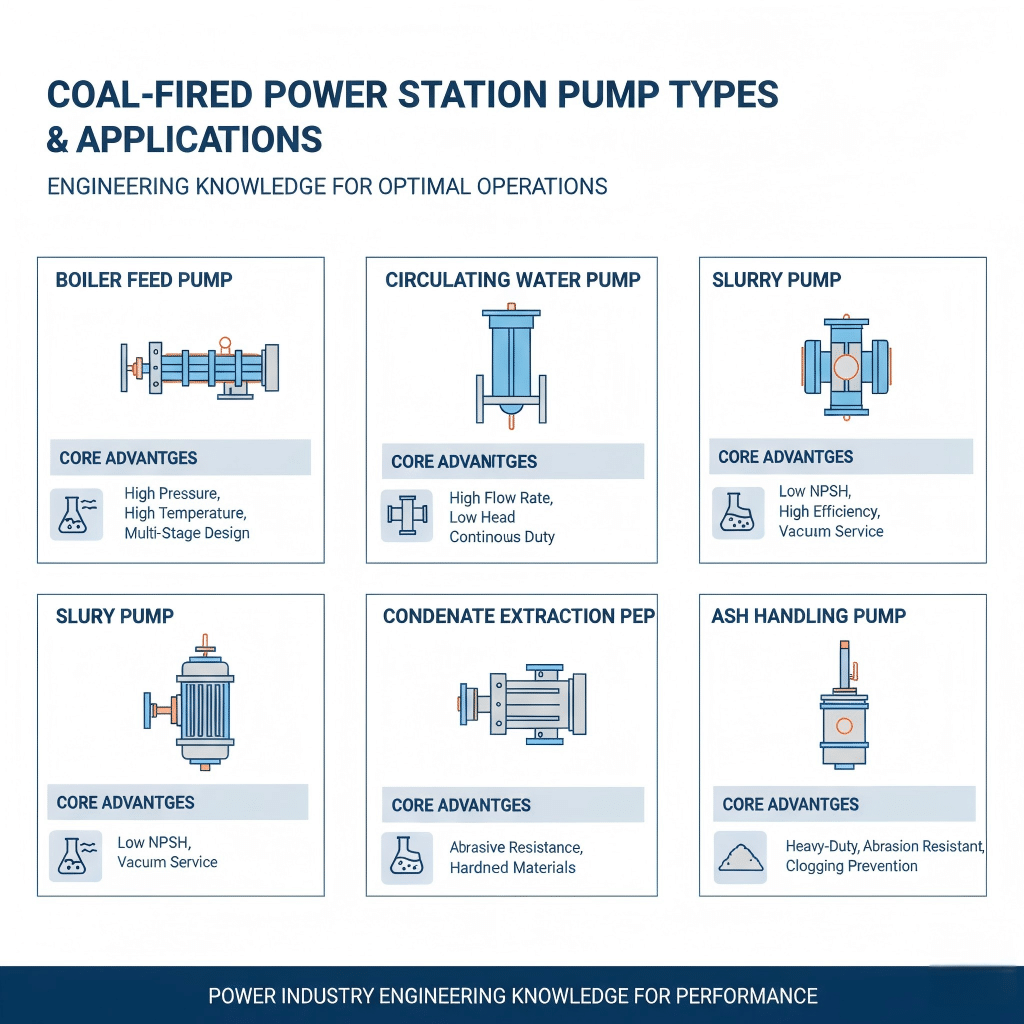
Different process links in coal-fired power stations have distinct requirements for pump performance. The following table lists the most widely used pump types (high-frequency search keywords on Google) and their core advantages in this scenario:
Pump Type | Core Advantages | Applicable Process Links |
|---|---|---|
High operational efficiency (up to 85-90%), stable flow output, low maintenance cost | Boiler feed water, condensate water transportation | |
Large flow capacity, balanced axial force, low vibration, operational efficiency up to 82% (higher than industry average of 78%) | Circulating cooling water system | |
Excellent anti-clogging and anti-winding performance, adaptable to high-solid-content media (solid content up to 35%) | Ash slurry, gypsum slurry transportation | |
Compact structure, direct pipeline installation, low energy consumption, suitable for medium-pressure circulation systems | FGD slurry circulation, chemical dosing system | |
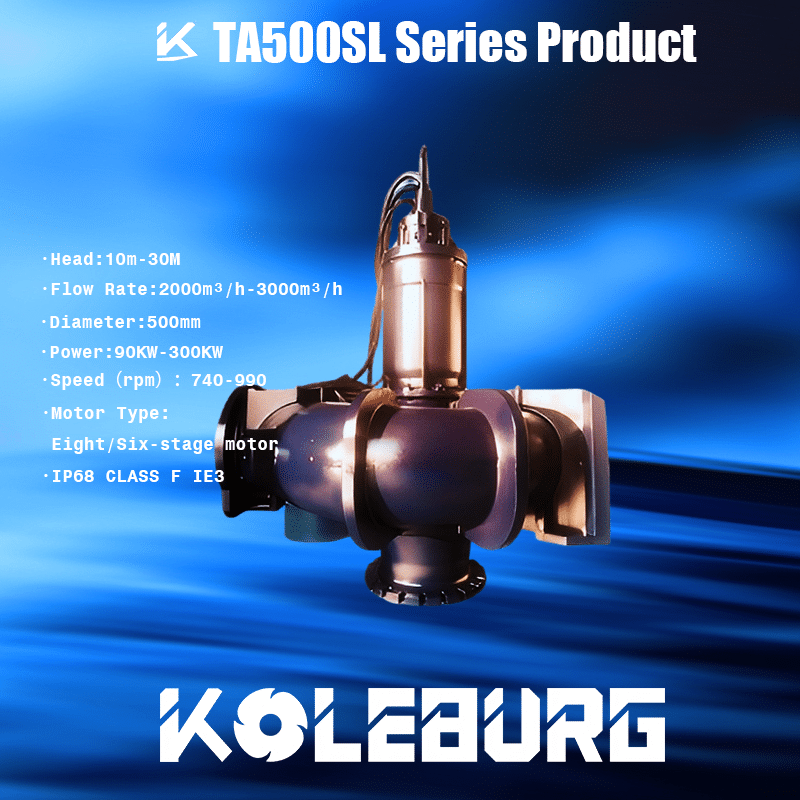
Submersible Ash Slurry Pump | Submersible installation saves space, built-in stirring device prevents ash sedimentation, high wear resistance | Ash pit cleaning, bottom ash transportation |
What is a Coal-Fired Power Station Pump?
Coal-fired power station pump is a specialized pump type designed for the harsh operating conditions of coal-fired power generation processes, which is a high-search-volume keyword on Google. It refers to a series of pump products that can adapt to high temperature, high pressure, abrasive solid particles, and corrosive media, and ensure long-term continuous and stable operation. These pumps are core auxiliary equipment in coal-fired power stations, undertaking key tasks such as energy conversion, medium transportation, and environmental protection treatment, and their operational reliability directly affects the safe and efficient operation of the entire power generation unit.
The working principle of coal-fired power station pumps varies by type: centrifugal-type power station pumps (such as boiler feed pumps) rely on high-speed rotating impellers to generate centrifugal force, realizing the升压 and transportation of media; positive displacement-type power station pumps (such as sludge pumps for ash treatment) rely on the volume change of sealed cavities to transport media, suitable for high-viscosity and high-solid-content media. The core performance indicators of coal-fired power station pumps include: maximum operating temperature (up to 350℃), maximum working pressure (up to 40MPa), maximum solid content adaptability (up to 45%), and annual operating reliability (≥99%).
Compared with ordinary industrial pumps, coal-fired power station pumps have the following unique characteristics:
- High temperature and high pressure resistance: Adopting special structural design and high-temperature resistant materials, it can operate stably under the conditions of high-temperature boiler feed water (150-350℃) and high pressure (10-40MPa).
- Strong wear and corrosion resistance: Key components are made of high-wear-resistant and corrosion-resistant materials (such as high-chromium alloy, silicon carbide, duplex stainless steel), which can resist the abrasion of fly ash particles and the corrosion of FGD slurry.
- High operational reliability: Complying with strict international standards, the structural strength is 1.2 times that of ordinary pumps, and the annual failure rate is ≤2 times, adapting to the 24/7 continuous operation demand of power stations.
- Energy efficiency optimization: Equipped with high-efficiency motors (IE3/IE4) and variable frequency control systems, it can adjust operating parameters according to load changes, reducing energy consumption by 15-50%.
Material Selection for Coal-Fired Power Station Pumps
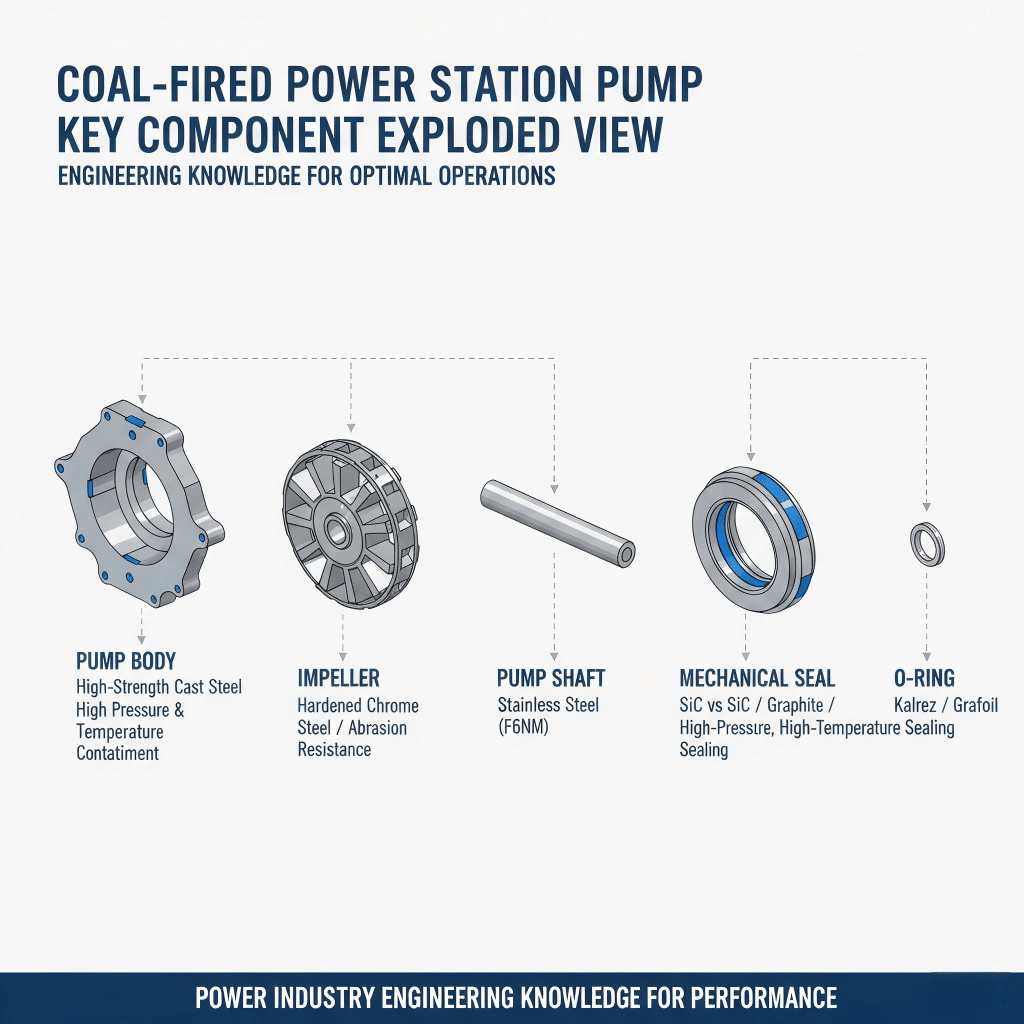
The harsh working conditions of coal-fired power stations (high temperature, high pressure, strong abrasion, strong corrosion) put forward strict requirements on the material selection of pump components. The following table lists the recommended materials for key components, combining the latest industry application practices and material performance data:
Pump Component | Recommended Materials | Advantages for Coal-Fired Power Scenarios |
|---|---|---|
304/316L Stainless Steel, High-Temperature Resistant Cast Steel, QT500-7 | 304/316L resists corrosion of FGD slurry; high-temperature resistant cast steel adapts to high-temperature boiler feed water (up to 350℃); QT500-7 ensures structural strength | |
High-chromium Alloy, Duplex 2205, Silicon Carbide | High-chromium alloy enhances wear resistance; Duplex 2205 resists high chloride ion corrosion; silicon carbide’s wear resistance is 3 times that of high-chromium alloy | |
42CrMo Alloy Steel, 316L Stainless Steel | 42CrMo provides high strength to withstand high-pressure impact; 316L prevents corrosion and ensures long-term stable operation | |
SiC-SiC, PTFE-coated Seal Ring | Excellent high-temperature resistance (up to 300℃) and sealing performance, avoiding leakage of high-temperature and corrosive media | |
FKM, EPDM | FKM resists high temperature (up to 200℃) and chemical corrosion; EPDM adapts to alkaline FGD slurry environment |
Energy Efficiency and Operational Reliability of Coal-Fired Power Station Pumps
Energy consumption is a key cost control link for coal-fired power stations. As the main energy-consuming auxiliary equipment, the energy efficiency of pumps directly affects the power generation cost and compliance with energy consumption limits. According to industry data, the power consumption of boiler feed pumps alone accounts for 3.15% of the unit’s total power generation, which is the largest energy-consuming equipment among unit auxiliary machinery. Improving pump energy efficiency through technological transformation can significantly reduce power generation costs.
The following table compares the energy efficiency of high-efficiency pumps and ordinary pumps in coal-fired power stations, and the energy-saving effect of typical transformation schemes:
Pump Type/Transformation Scheme | Energy Efficiency Rate (%) | Annual Energy Savings (kWh/unit) |
|---|---|---|
Ordinary Centrifugal Pump (IE2 Motor) | 70-75 | 0 (Reference Benchmark) |
High-Efficiency Centrifugal Pump (IE4 Motor) | 85-94 | 12,000-18,000 |
High-Speed Direct-Drive Variable Frequency Transformation | 88-95 | 40,000-60,000 (based on 300MW unit) |
Operational reliability is critical for coal-fired power stations with continuous production needs. Pumps complying with API 610 standard have a failure rate 30-40% lower than ordinary pumps, and their average service life can reach 5-8 years. The key measures to improve operational reliability include: selecting appropriate materials according to working conditions, regular maintenance of wear parts (such as impellers and mechanical seals), and adopting intelligent monitoring systems to realize real-time fault early warning. For example, the intelligent monitoring system can monitor parameters such as pump vibration, temperature, and pressure in real time, reducing unplanned downtime by 50%.
Application Case of Pumps in Coal-Fired Power Stations

This case involves a large-scale coal-fired power station with a total installed capacity of 1200MW (4×300MW units). The power station’s production process includes boiler feed water, ash slurry transportation, FGD slurry circulation, and circulating cooling water supply. The core challenge is to ensure the stable operation of pumps under high-temperature, high-pressure, and abrasive/corrosive working conditions, while meeting the requirements of the new energy consumption limit standard GB 21258—2024.
Project Background and Requirements
Process Link | Medium Characteristics | Operational Requirements |
|---|---|---|
Boiler Feed Water | High-temperature feed water, temperature 280℃, pressure 25MPa, no solid particles | Continuous operation, high temperature and high pressure resistance, energy efficiency rate ≥88%, operational rate ≥99.5% |
Ash Slurry Transportation | Fly ash slurry, solid content 30-35%, maximum particle size 25mm, high abrasion | Anti-clogging, high wear resistance, flow rate 180m³/h, head 45m |
FGD Slurry Circulation | Gypsum slurry, pH 5-6, chloride ion concentration 8000mg/L, corrosive | Corrosion resistance, stable circulation, flow rate 250m³/h, head 30m |
Circulating Cooling Water | Clean water, temperature 30-45℃, non-corrosive, large flow | Large flow capacity, low energy consumption, flow rate 1200m³/h, head 25m |
Pump Selection and Configuration Scheme
Process Link | Selected Pump Type | Material Configuration & Key Technology |
|---|---|---|
Boiler Feed Water | Pump body: High-temperature resistant cast steel; Impeller: 316L Stainless Steel; Equipped with IE4 motor and variable frequency control system | |
Ash Slurry Transportation | Pump body: QT500-7; Impeller: Silicon Carbide; Built-in stirring device | |
FGD Slurry Circulation | Pump body: Duplex 2205; Impeller: Duplex 2205; Mechanical seal: SiC-SiC | |
Circulating Cooling Water | Pump body: 304 Stainless Steel; Impeller: 304 Stainless Steel; Optimized flow channel design |
Project Operation Effect
Evaluation Index | Design Target | Actual Operation Result |
|---|---|---|
Pump Operational Rate | ≥99.5% | 99.8% |
Average Energy Efficiency Rate | ≥88% | 92.3% |
Annual Energy Savings | ≥2 million kWh | 2.8 million kWh |
Failure Rate | ≤2 times/year | 1 time/year |
Compliance with Energy Consumption Standards | Meet GB 21258—2024 | Compliant (unit power consumption reduced by 1.2%) |